Measured on production builds
Every number comes from node build or a production preview, never the dev server. The date, the versions and the script sit next to it.

For SvelteKit developers and tech leads. I measure the patterns that look fine in development and break under real traffic, then ship each fix as a guide, a rule file your AI assistant reads, and a test your repo runs.
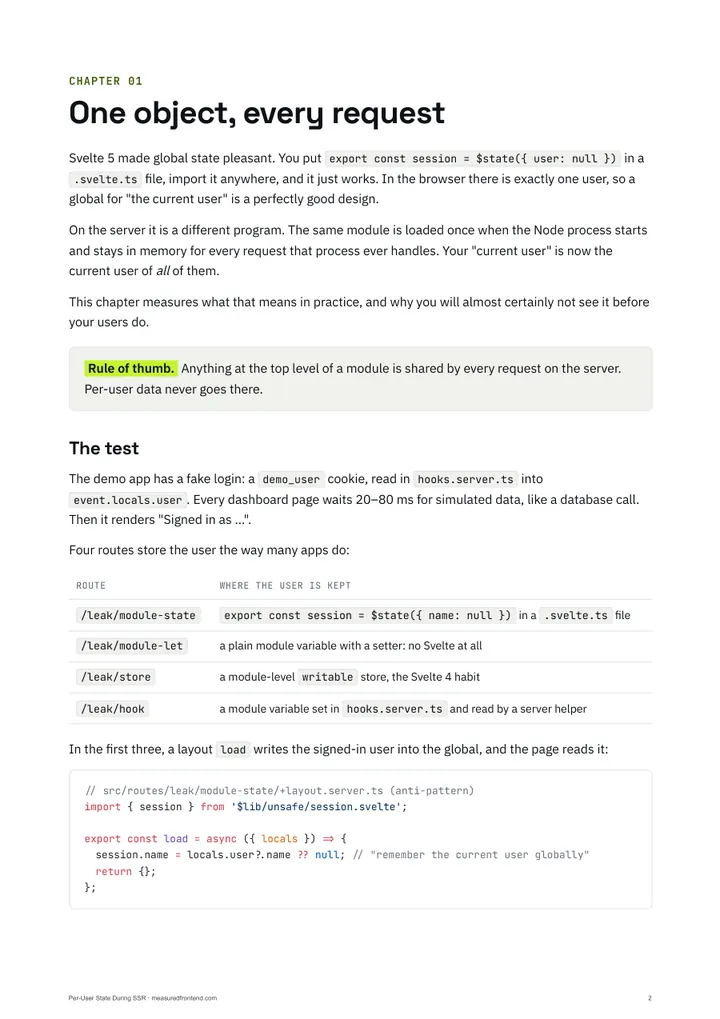
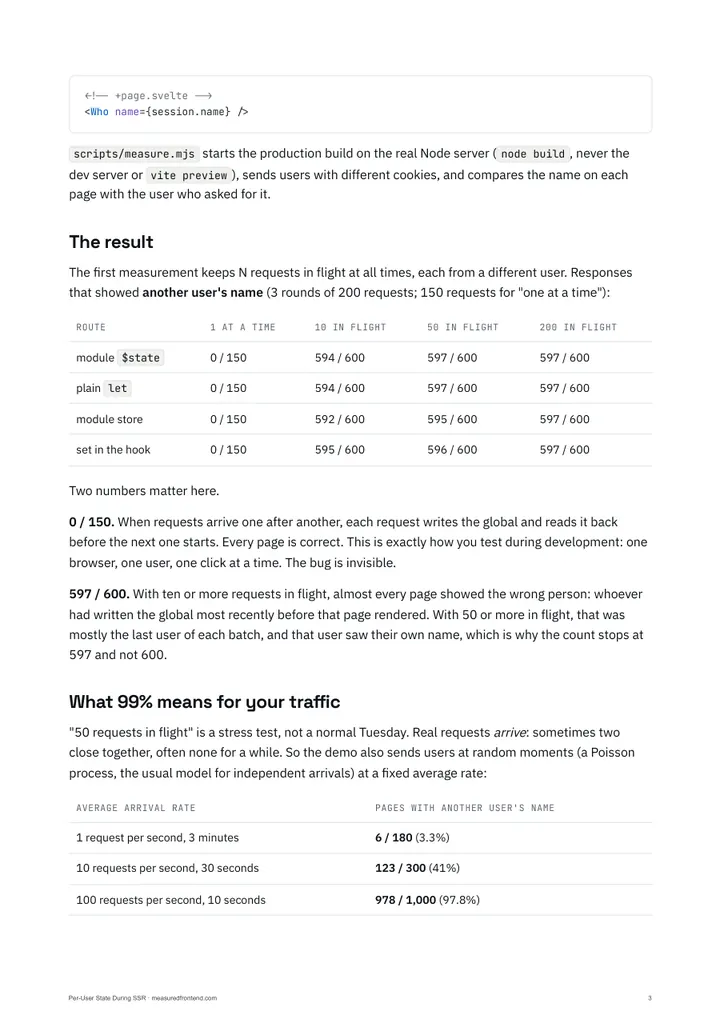
Example: module-level $state passes review, then shows users each other's data. 0 of 150 pages wrong one request at a time, 594 of 600 with 10 in flight.
I use one every day. It writes what it has seen most, usually code that works when one person clicks through the app. The pack gives it the rule in the format it reads, and gives you the test that fails when the rule is broken.
Every number comes from node build or a production preview, never the dev server. The date, the versions and the script sit next to it.
Each rule names a test. The drop-in tests run against your app, so you check the fix instead of trusting it. Mine included.
Svelte and SvelteKit change often. When they do, I rerun the demos and update the rules. The Measured Rules tier is planned with 12 months of updates.
What I haven't measured: how often assistants write these bugs. What I have measured: what the bugs do once they ship, and which fix holds.
Each topic: a small SvelteKit app written from scratch, a measure script, the tests behind every rule, a one-page checklist, and soon a guide with Measured Rules. All four demo repos are public on GitHub (MIT).
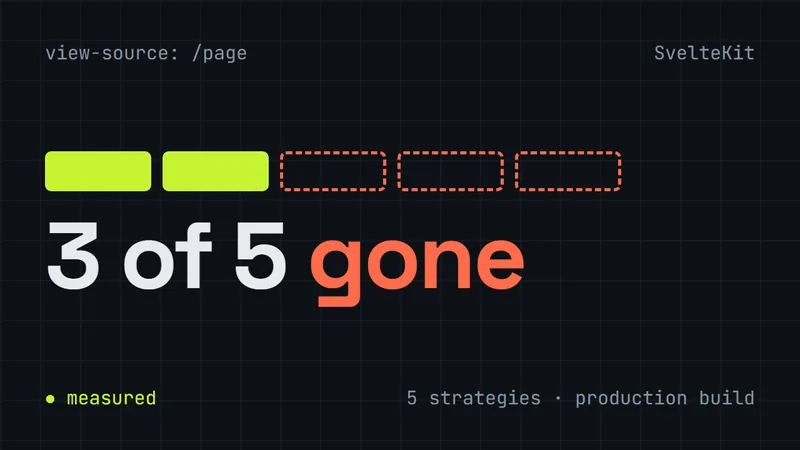
2 of 5 sections in the server HTML with {#await import()}
demo public (MIT) · guide soon
Read the measurements →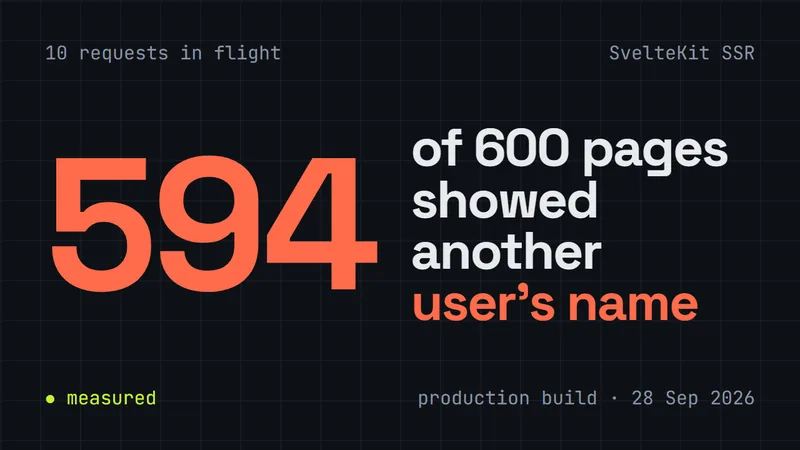
594 of 600 pages showed another user’s name, 10 requests in flight
demo public (MIT) · guide soon
Read the measurements →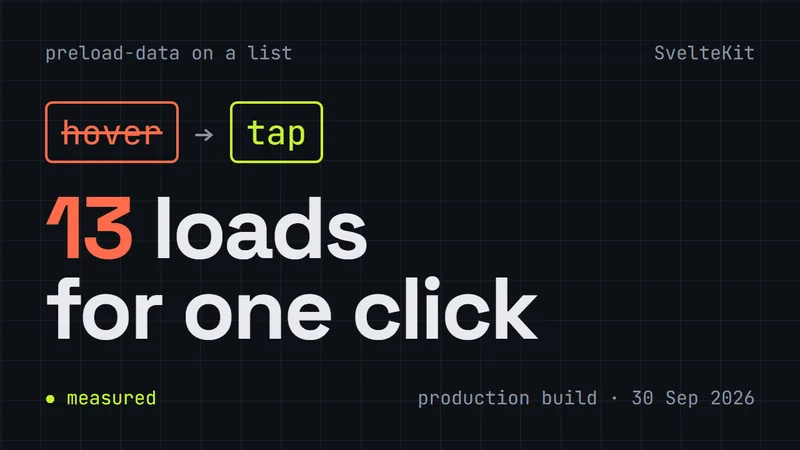
13 server loads for one opened page, reading a list with hover preloading
demo public (MIT) · guide soon
Read the measurements →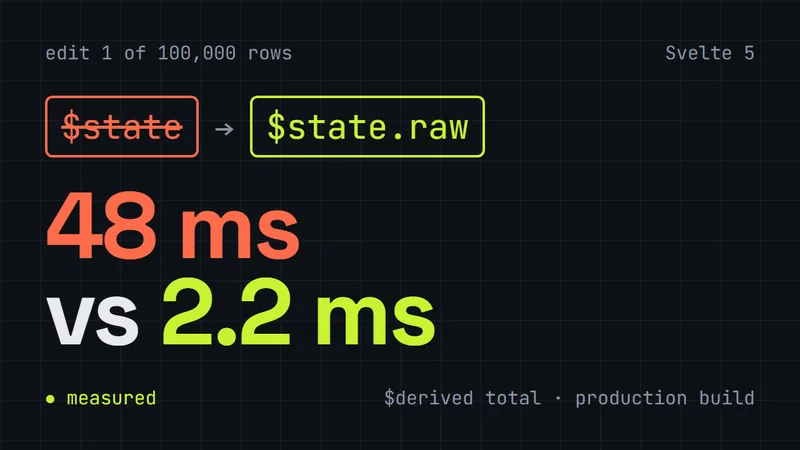
48 vs 2.2 ms to edit one of 100,000 rows with a $derived total: $state vs $state.raw
demo public (MIT) · guide soon
Read the measurements →A small demo app, written from scratch for the topic, built and served by node build. Here, 20 other users load the same dashboard while I load it as User you. JavaScript is off, so this is the server HTML.


A script keeps N requests in flight and counts every page that shows the wrong user. The raw results go in a JSON file with the date, versions and machine. The site, the guide and the video quote that file.
{
  "env": {
    "date": "2026-10-09T08:51:27.058Z",
    "svelte": "5.57.1", "kit": "3.0.1",
    "server": "node build (adapter-node), production build, localhost"
  },
  "routes": {
    "/leak/module-state": [ …
      {
        "concurrency": 10,
        "requests": 600,
        "otherUser": 594,
        "otherUserPerRound": [198, 197, 199],
        "examples": ["User u000 saw \"User u010\"", …]
      }, …
Every rule gets a test in the demo. A rule without a passing test doesn't ship. The same tests come with the pack, so you can run them against your app.
Before anything is published it gets a fresh technical review and a separate IP review; fixes get a second fresh review. The full process. When a measurement proves me wrong, it goes on the corrections page.
$ bun run test:pack
PASS T1 (rule 1) … module-level $state leaks between concurrent requests  {"otherUser":"198/200"}
PASS T4 (rule 6) the same code shows no leak when requests arrive one at a time  {"otherUser":"0/50"}
PASS T7 (rule 2) load data passed as props: no leak at 50 and 200 concurrent users  {"otherUser":"0/400",…}
PASS T14 (rule 4) a server helper using getRequestEvent() reads the right request, …  {"otherUser":"0/400"}
…
16/16 passed
dist/
├─ AGENTS.md
├─ claude/sveltekit-ssr-state/SKILL.md
├─ cursor/sveltekit-ssr-state.mdc
├─ copilot/sveltekit-ssr-state.instructions.md
├─ extras/
│  ├─ tests/concurrent-users.mjs
│  ├─ prompts/audit.md
│  └─ pr-checklist.md
├─ CHANGELOG.md
└─ README.md
Season 1 bundle: all four topics, Guide + Measured Rules for €99 (base price (bazna cijena) on 16.10.2026: €99). Or pick any three topics for the price of two.
Sales open soon. The waitlist hears first. Prices in euro, VAT included. A business can enter its VAT ID at checkout; reverse charge then applies where the law allows.
One page per topic, every check backed by a measurement: section renderer, ssr state, sveltekit defaults and big lists in svelte 5 state.
After that: one email when the guides open, and a short note when a new measurement is published. Unsubscribe in one click. No confirmation, no emails: the address is deleted within 30 days.
Keep using it; I do. An assistant writes the common pattern, and the common pattern is often the one that passes review and fails under load, like a module-level store for the current user. I haven't measured how often assistants write it. I measured what it does once it ships: 594 of 600 pages with the wrong name at 10 requests in flight. You get that measurement, a rule file your assistant reads, a test that fails in your repo when the rule is broken, and a rerun when Svelte changes.
Sales open soon. The waitlist hears first: the four checklists as soon as you confirm your address, a short note when a new measurement is published, and one email when the guides open.
The four one-page checklists, the demo apps with their measure scripts and tests (MIT, all four public on GitHub), the first rules of each pack in the demo READMEs, and every number on this site. The guide explains the why and the edge cases; Measured Rules make your assistant use the fix and give you the test.
You land on the mailing-list page, get one confirmation email from hello@measuredfrontend.com, click the link, and the confirmation page lists the four PDFs. No confirmation, no emails, and the address is deleted within 30 days.
Not exactly. Absolute times come from one machine (Windows 11, i9-13900KF) and are labelled with versions and dates. The pass and fail results, and the ratios, are what carry over. Every demo has the script, so you can rerun it on yours.
Season 1: measured on SvelteKit 2.70 between 27 and 30 September 2026 and re-tested on SvelteKit 3.0.1 on 9 October 2026 (Svelte 5.57, Node 26). Each topic page lists its exact versions. Each update says what was re-tested and on which versions.
4 things, all published with the test that caught them: the <svelte:boundary> claim in the lazy CMS sections topic, an early hydration-delay claim, the vite preview streaming claim in the SvelteKit defaults topic, and the heap numbers of a probe in the $state.raw topic. The list, with dates, is on the corrections page.
Yes, with the Team licence: up to 10 developers of one company, and you can commit the rules to all of your company's repos.