vs 1,900 bytes
Data transferred on the scan path: hover (median 24,564 bytes) vs tap. Server load counts are exact; byte counts are medians.

The scaffold turns on hover preloading for every link. Reading a list became 13 server loads for one opened page. And streamed data never made it into the HTML markup.
Server loads for one opened page
With hover, every link the pointer rests on for about 20 ms runs that page's load. On a navigation bar that's cheap and makes clicks feel instant. On a list people read, it is many server loads for one page view.
Streaming has a similar trap. An un-awaited promise from a server load makes the first byte fast, but the content is not in the HTML markup. It arrives later in an inline script. Readers that strip scripts, and browsers without JavaScript, see the placeholder.
<!-- src/app.html -->
<body data-sveltekit-preload-data="hover">
Real Playwright mouse events at 60 Hz on a production build. Median of 5 runs, range in brackets. Server load 150–300 ms. Windows 11, i9-13900KF.
| Pointer path | hover | tap | false | list tap |
|---|---|---|---|---|
| scan: rest on 12 rows, open 1 | 13 | 1 | 1 | 1 |
| skim: slide over 24 rows, open 1 | 1 (1–2) | 1 | 1 | 1 |
| navBrowse: rest on 5 nav links, open 1 | 5 | 1 | 1 | 5 |
| nav / direct | 1 (nav 1–2) | 1 | 1 | 1 (nav 1–2) |
Data transferred on the scan path: hover (median 24,564 bytes) vs tap. Server load counts are exact; byte counts are medians.
With a 300 ms load and a 300 ms rest, hover showed the page 95 ms after the press. Preloading off: 407 ms. Tap: 313 ms. The gain is capped by how long the pointer rests.
With the product streamed and the head waiting for it, the served HTML had no <title> and no meta description, and 191 instead of 989 characters of text.
First HTML, product page
On vite preview, streaming looked broken: readable HTML at 812 ms although the first byte came at 156 ms. The cause is its gzip middleware, which doesn't flush. My own earlier probe got this wrong, and the guide says so. Measure streaming on node build with a client that asks for gzip, like every browser.
Your assistant keeps writing the code. The rules tell it which pattern to use and why, in the format it reads: a Claude skill, a Cursor rule, Copilot instructions or AGENTS.md. Every rule names the test that backs it.
Rules 3 and 7 are free in the demo README. The pack adds the rest, templates, an audit prompt, a PR checklist and the tests to run in your own repo.
vite preview trap.€19 PDF
Base price (bazna cijena) on 16.10.2026: €19
€39 PDF + AI pack
Base price (bazna cijena) on 16.10.2026: €39
€199 up to 10 developers
Base price (bazna cijena) on 16.10.2026: €199
Planned prices. Sales open soon. The waitlist hears first. Season 1 bundle: all four topics, Guide + Measured Rules for €99 (base price (bazna cijena) on 16.10.2026: €99), or any three topics for the price of two. Prices in euro, VAT included. Payment goes through Paddle, the merchant of record; a business can enter its VAT ID at checkout, and reverse charge then applies where the law allows.
One page per topic, every check backed by a measurement: section renderer, ssr state, sveltekit defaults and big lists in svelte 5 state.
After that: one email when the guides open, and a short note when a new measurement is published. Unsubscribe in one click. No confirmation, no emails: the address is deleted within 30 days.
"hover" is the scaffold default, so it is in most SvelteKit apps, whoever wrote the code. The question is what it costs on your pages. Here it is measured, and the pack gives your assistant the scoping rules plus a script that counts the loads on your own app.
No. Keep hover on navigation. With a 300 ms load, the page appeared after 95 ms with hover (after a 300 ms rest) vs 407 ms with preloading off. Scope it on lists, where one page view can start many loads.
It is one scripted path: resting on 12 rows of a list, then opening one. It is not an average of real users. Per 1,000 visitors who follow that path, that is 13,000 server loads instead of 1,000, under that stated assumption.
Agreed for Google. But readers that strip scripts and browsers with JavaScript off see the placeholder. And a <svelte:head> that awaits streamed data rendered no <title> and no meta description in the served HTML (without experimental async SSR).
Both options are documented, and I quote the docs in the guide. What I add: the measured cost on realistic pointer paths, the swipe case on phones, the one-slot cache, the latency ceiling, the head and meta consequence, and the gzip trap with vite preview.
Sales open soon. The waitlist hears first: one email when it opens, and the free SvelteKit defaults checklist right after you confirm.
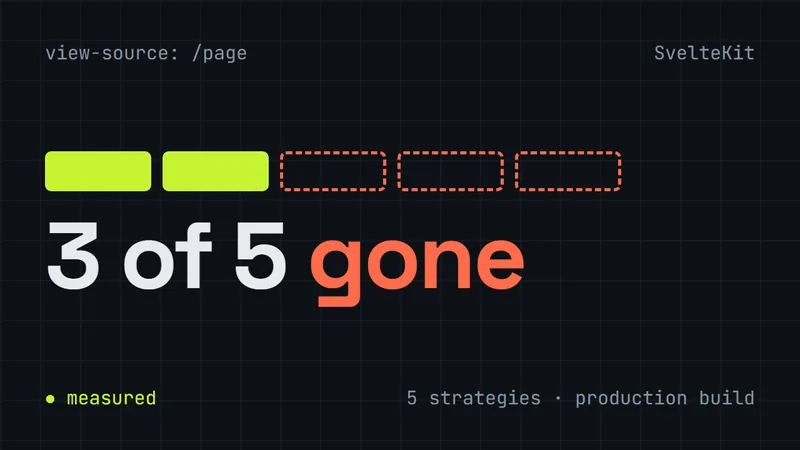
2 of 5 sections in the server HTML with {#await import()}
demo public (MIT) · guide soon
Read the measurements →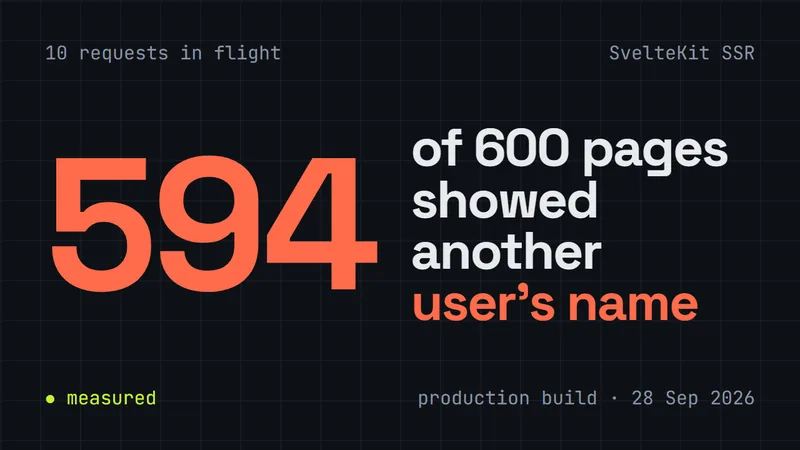
594 of 600 pages showed another user’s name, 10 requests in flight
demo public (MIT) · guide soon
Read the measurements →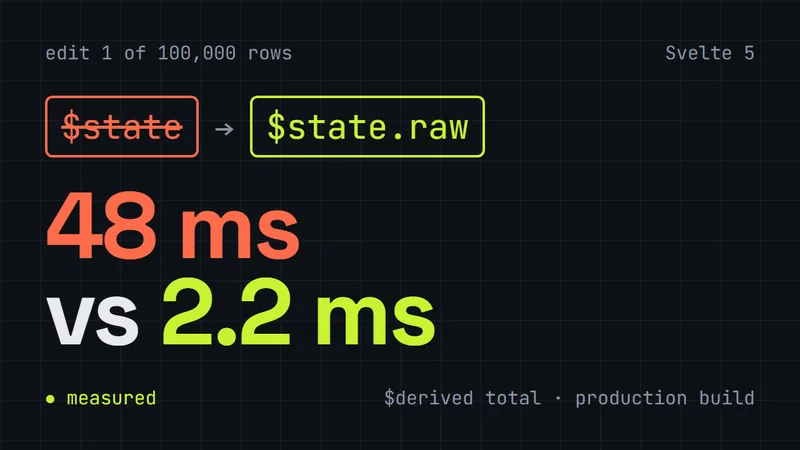
48 vs 2.2 ms to edit one of 100,000 rows with a $derived total: $state vs $state.raw
demo public (MIT) · guide soon
Read the measurements →